Full day
Main sights by van
Ibirapuera to Paulista
- Length7 hours
- StartBrooklin pickup
- GuideEnglish, Spanish, Portuguese
Spot your stop
Brief answer
The main Sao Paulo sights trace its history: the Pateo do Collegio where the city began, the Se Cathedral, the Theatro Municipal, the Copan and Edificio Italia towers, MASP and Ibirapuera Park.
Key dates
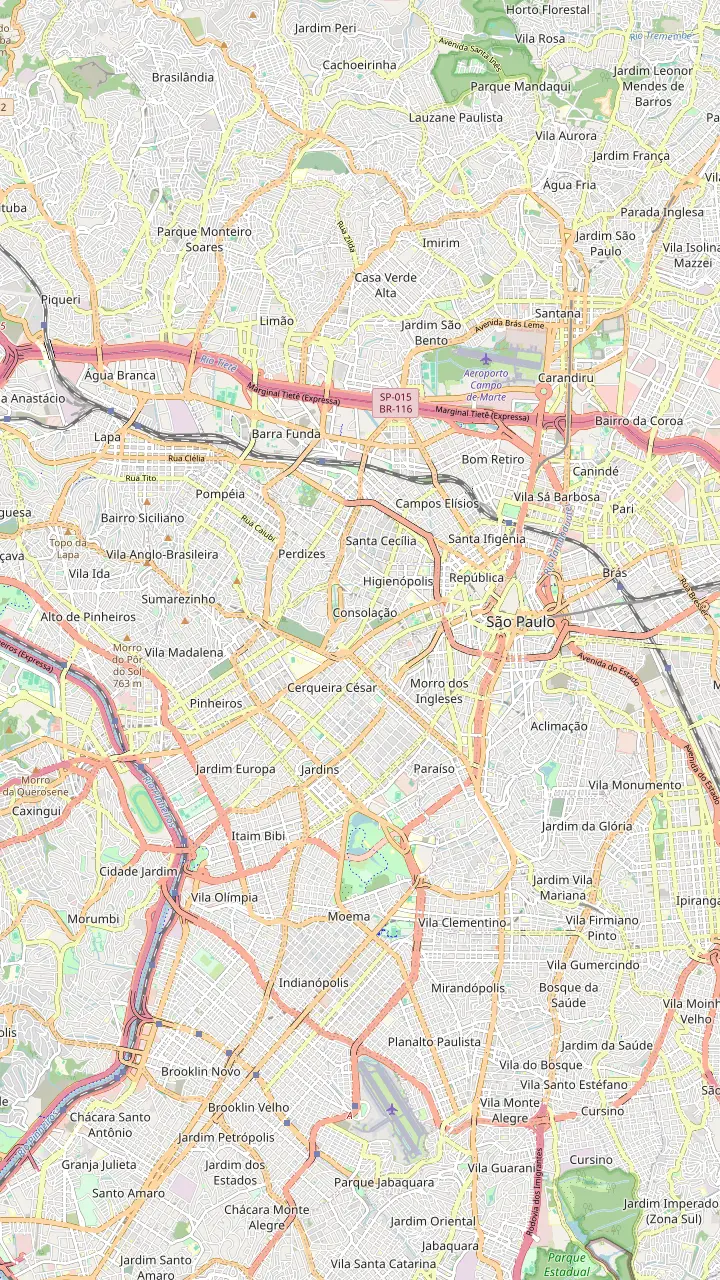
Map of 31 stops
Select a route, then press a pin or stop to read its note and open Google Maps.
Opened in 1933; Monday to Saturday 6 AM to 6 PM, Sundays and holidays until 4 PM.
Google MapsThe metro exit opens straight onto the square; nearby streets go car-free on Sundays and holidays.
Google MapsChefs' stalls, among them one selling produce from 5 Brazilian biomes.
Google MapsOn Rua Treze de Maio, the street of the Bixiga cantinas; its festival fills every August weekend.
Google Maps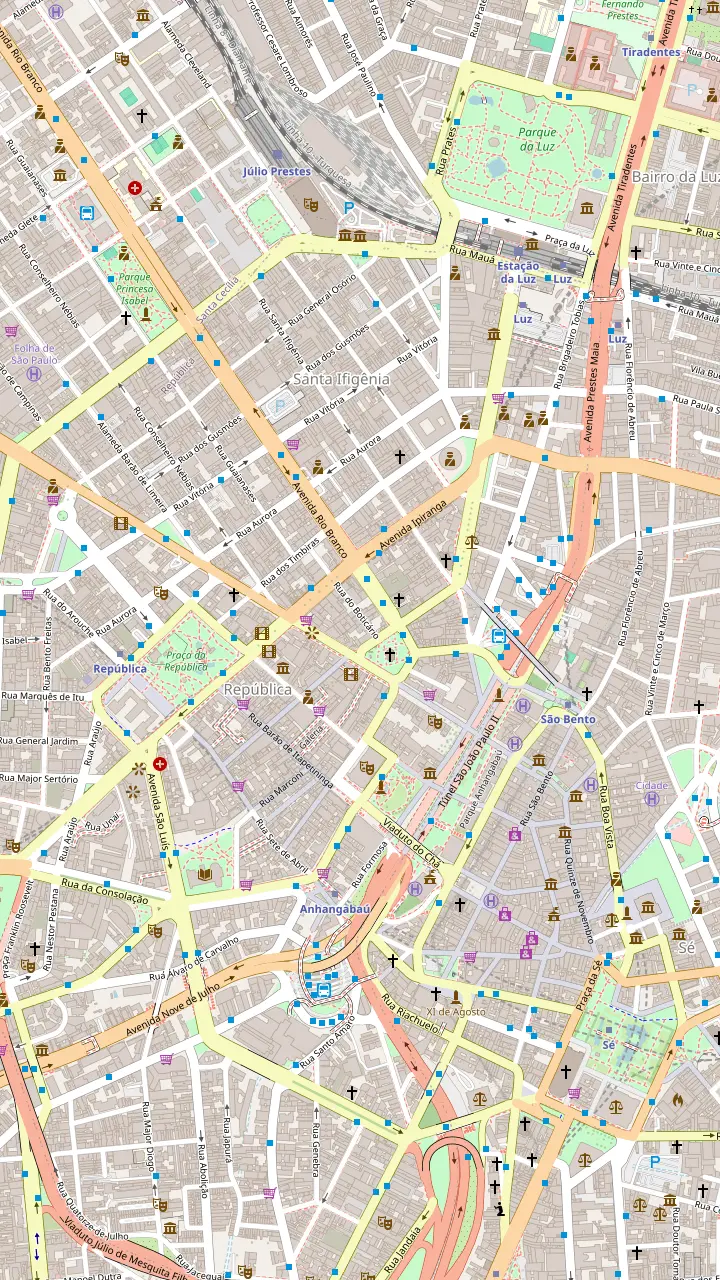
Where a Jesuit college was founded on 25 January 1554; its museum opened in 1979.
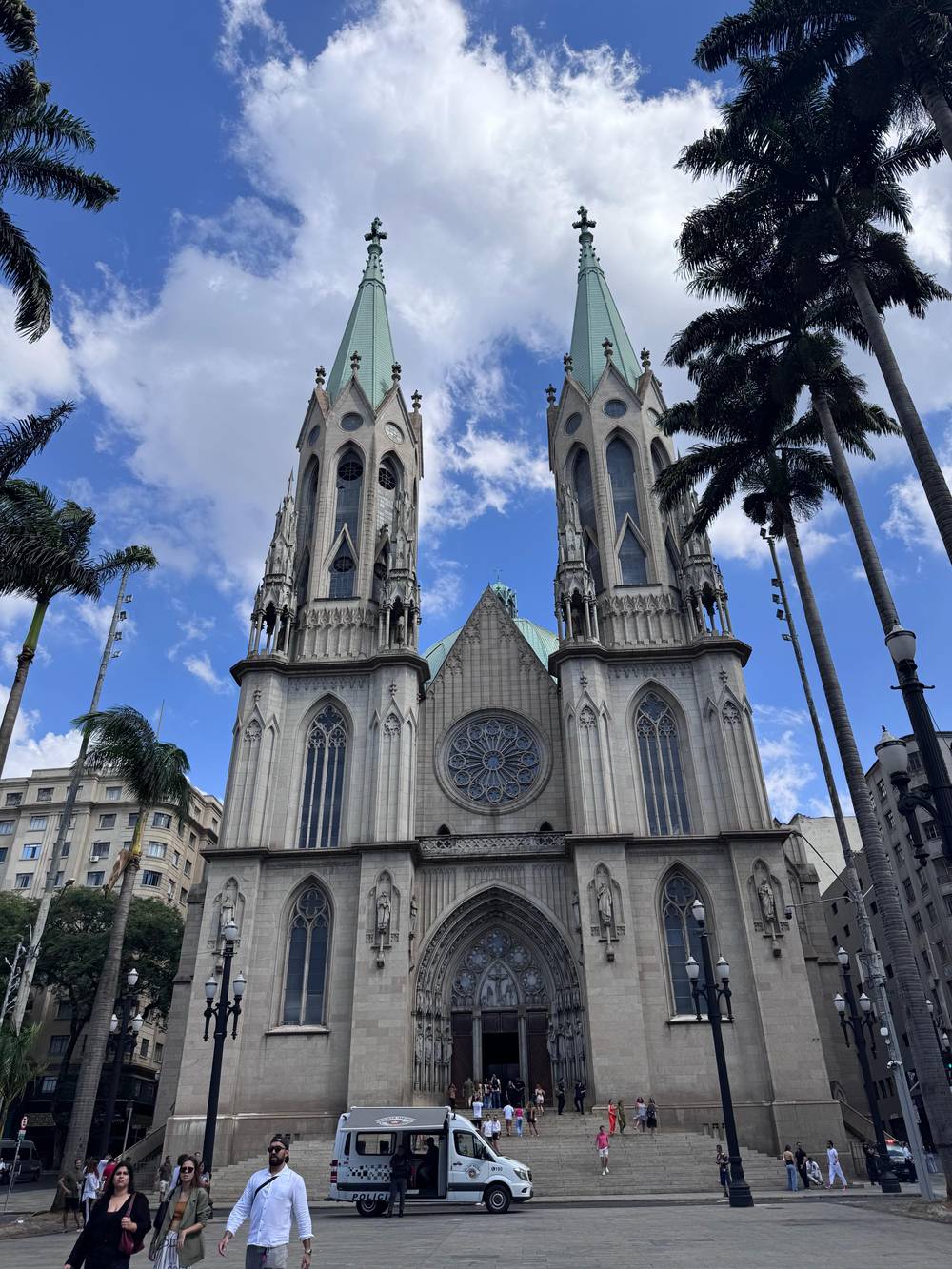
Google MapsGothic, 111 m long; begun in 1912 and inaugurated in 1954.
Google MapsA baroque landmark in the middle of the modern centre, in the city's own words.
Google MapsOpened in September 1911; free guided visits are released the day before.
Google MapsThe viaduct the 7-hour tour crosses on its way through the centre.
Google MapsOscar Niemeyer's wave, designed in 1951: 140 m, 37 floors, 1,160 apartments.
Google Maps165 m tall, with a viewpoint and a restaurant at the top.
Google MapsPina Luz, in the city's oldest art museum, founded in 1905; free on Saturdays.
Google MapsHome of the Museum of the Portuguese Language, reopened in July 2021.
Google Maps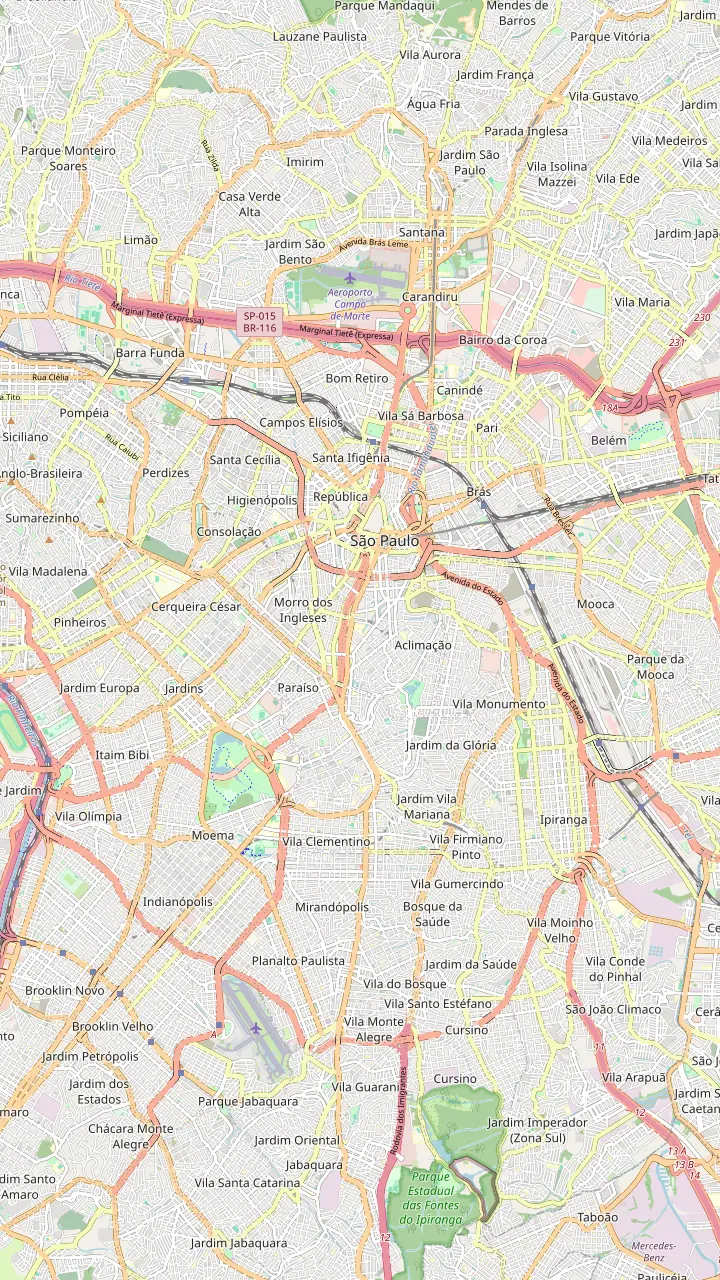
On Paulista Avenue since 1968; free for everyone on Tuesdays.
Google MapsA photo stop on the 7-hour tour, near the Bandeiras Monument.
Google MapsAt the gateway of Ibirapuera Park, which opened on 21 August 1954.
Google MapsA palace built as a monument to the independence of 1822; free on Wednesdays.
Google Maps15 themed rooms under the stands of the Pacaembu stadium.
Google MapsAt Rua Visconde de Parnaiba, 1316, with a studio for old-style portraits.
Google Maps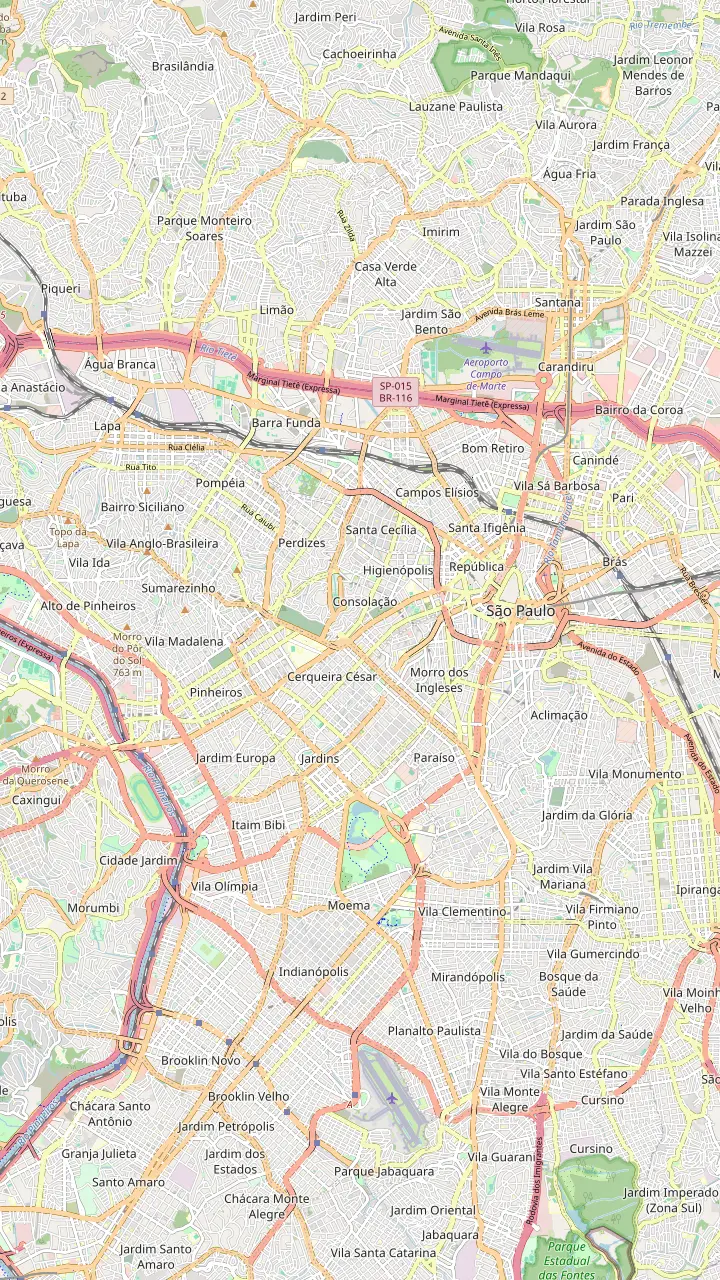
Murals that change constantly, and a craft fair at weekends from 9 AM to 6 PM.
Google Maps350 m and 96 steps covered in tiles with art and poetry.
Google MapsLuxury shopping in the Jardins, planted with purple ipe trees.
Google MapsFloors 7, 8 and 9 of the Bunkyo building, with more than 97,000 objects.
Google MapsCar-free at weekends from 7 AM to 9:45 PM, with graffiti panels on the buildings.
Google Maps
Start of every day trip; Santos lies 72 km away.
Google MapsThe old coffee exchange, temporarily free while exhibitions change.
Google MapsArts fair on Saturdays, Sundays and holidays, 30 minutes from central Sao Paulo.
Google MapsThe railway village 30 km from central Santo Andre.
Google MapsCapivari, the centre of a town at 1628 m, 173 km from Sao Paulo.
Google Maps83% state park, reached by ferry from Sao Sebastiao.
Google Maps175 km away on the Dutra highway; it holds 30,000 to 45,000 people.
Google Maps© OpenStreetMap contributors · map data
The Sao Paulo sights worth your time, read as a timeline: a Jesuit hilltop, a Gothic cathedral, a theatre paid for by coffee, curving towers and a park built for a birthday.
Editorial team, saopaulocitytour.com · Updated November 11, 2026 · ~7 min read
The essentials
Every list of Sao Paulo sights should start where the city itself started. The municipal council dates the beginning to a Jesuit college raised on 25 January 1554 on a hill between the Anhangabau and Tamanduatei rivers.1 That hill is the Pateo do Collegio, a whitewashed square a short walk from the cathedral. It looks modest next to the towers around it, and that contrast is the point: this is the seed from which a metropolis of 11.45 million people grew.7
The memorial building you see today keeps 2 walls left over from the 16th and 17th centuries.8 Inside, the Museu Anchieta, open since 1979, uses panels, maps and a scale model to show how the site changed from 1554 onward.9,10 Give it half an hour before you head into the busier streets. It is the best way to picture the clearing, the river valleys and the mission that came before the asphalt.
Growth came slowly. Only in 1681 did the Marquis of Cascais move the capital of the captaincy to the town of Sao Paulo, and the town was made a city in 1711.11,12 The first parish church, the ancestor of today's cathedral, had taken from 1598 to 1612 to build after permission arrived in 1591.13 Keep those dates in mind as you walk: almost everything grand in the centre is far younger than the street plan beneath it.
Plan your visits
| Landmark | Look for | Free entry |
|---|---|---|
| Theatro Municipal | Gilded halls, Semana de 22 stage | Guided visits |
| Pinacoteca | Brazilian painting and sculpture | Saturdays |
| Ipiranga Museum | Independence palace | Wednesdays |
| MASP | Glass easels, open plaza | Tuesdays |
| Pateo do Collegio | Old walls, city model | Ask at the door |
Free entry as each venue states it; check the venue's own page before you go.4,26,27,28
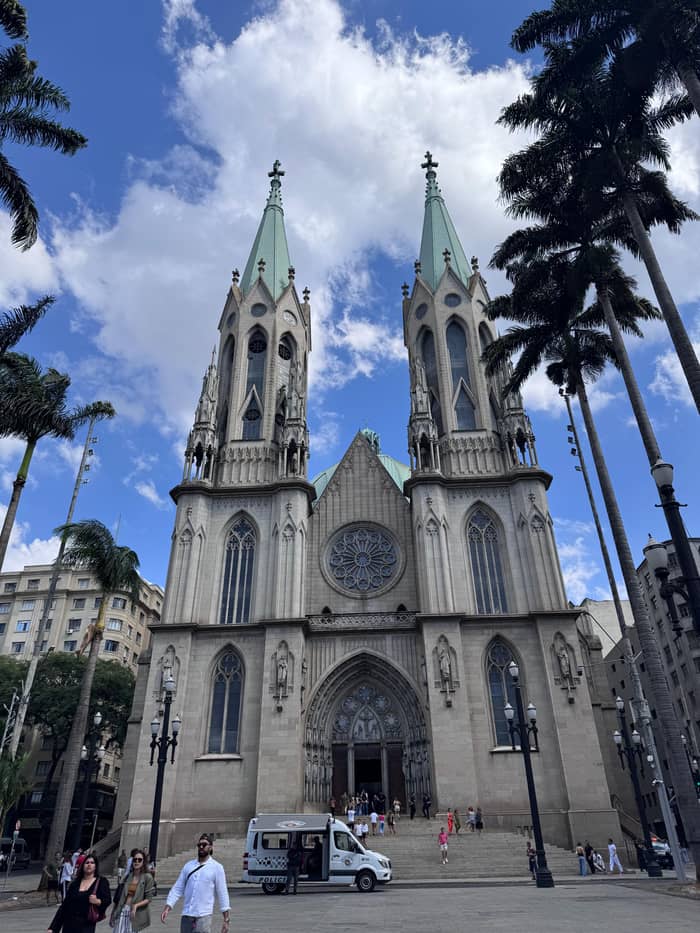
A short walk south, the Se Cathedral fills the square that gives it its name. The archdiocese gives its size plainly: 111 m long, 46 m wide and 65 m high, before you count the towers.2 Maximilian Hehl, a professor at the Escola Politecnica, drew it as a Gothic church.17 Building began in 1912 and the doors opened only in 1954, on the city's 4th centenary.18,14 The archdiocese blames the wait on money shortages and the 2 world wars, which held up imported materials.19
Inside, look up and then look closer. Carvings inside and outside hide Brazilian animals, among them a toad, an armadillo, a toucan, a lizard and a heron.20 The Italian-built organ is described as the largest in South America, with 5 manuals and about 12,000 pipes, and the carillon in the towers holds 61 bells.21,22 On a weekday morning the nave is quiet enough to hear the city fall away outside the doors.
Below the altar is a crypt, opened in 1919, with 30 burial chambers.23 It also holds the remains of chief Tibirica, whom the church calls the first citizen of Piratininga.24 That single tomb links the cathedral back to the hilltop college and to the people who lived here before the Jesuits arrived. Ask at the entrance whether the crypt is open on the day you visit.
From the cathedral, follow the crowds west across the Tea Viaduct, the Viaduto do Cha, which this site's tour also passes. At the far end stands the Theatro Municipal. The theatre explains its own origin frankly: a high society grown rich in the coffee cycle wanted a stage that matched its European tastes.31 The Ramos de Azevedo office signed the design with the Italian brothers Claudio and Domiziano Rossi.32
Work started in 1903 and the building was handed over 8 years later.33 When it opened in September 1911, a crowd of 20,000 gathered to watch the guests arrive.3 The theatre also says its building was the first to be supplied entirely with electric power.34 Its stage later hosted the Semana de 22, the week of art and poetry that launched Brazilian modernism, so the house of coffee money became the cradle of the avant-garde.35
You can see the gilded halls without a concert ticket. Free educational visits are released on the INTI platform the day before, from 10 AM, and the visits in Portuguese run Wednesday to Friday at 11 AM, 1 PM, 3 PM and 5 PM.4,36 Tours in English are booked in person with an identity document and passport.37 The nearest metro station is Anhangabau.38 Be online at 10 AM the day before, since the free places are limited.
Pick your landmarks
Match what you are curious about to the place that tells it best.
If I want the city's beginning
Start at the Pateo do Collegio
Its museum shows how the site changed from 1554 on.10
If I love grand interiors
Book a free theatre visit
Slots are released on INTI the day before.4
If I want a view
Ride up the Edificio Italia
A viewpoint and a restaurant sit at the top.6
If I like modern architecture
Walk the Copan and MASP
If I travel on a budget
Go on Saturday
The Pinacoteca is free for everyone that day.26
Ways to see them
Full day
Ibirapuera to Paulista
Short walk
Copan to the cathedral
Architecture
Liberdade to Largo da Memoria
North of the centre, the Luz district gathers the museums that explain who built the city. The Pinacoteca, founded in 1905 by the state government, is Sao Paulo's oldest art museum.48 Its focus is Brazilian art from the 19th century to the present, with work by Anita Malfatti, Tarsila do Amaral and Candido Portinari.78,79 A single ticket covers its 3 buildings for the day, and on Saturdays entry is free for everyone.80,26
Across the park, the Luz railway station houses the Museum of the Portuguese Language. The museum notes that the station was one of the main entry points for immigrants arriving in Brazil.49 The museum first opened in 2006, a fire destroyed it at the end of 2015, and the rebuilt museum reopened in July 2021.81,82,50 It is an interactive space, more about voices and words than glass cases, and it works well even if you speak no Portuguese.
To follow the newcomers further, ride east to Mooca and the State Immigration Museum, which keeps the story of the people who arrived through the Bras Immigrant Hostelry.83 Its garden of about 2,900 m² is a calm place to sit after the exhibition.84 In Liberdade, the Museum of Japanese Immigration, opened in 1978, keeps more than 97,000 objects on the upper floors of the Bunkyo cultural centre.85,62
Price a landmark tour
Choose a route and enter your party size.
Review 4 options
Choose a route and enter your party size.
≈
View≈
View≈
View≈
ViewStarting prices on GetYourGuide, exchanged at the ECB reference rate. The booking page gives the exact price.
History in the stones
1554
Jesuits raise a college between the Anhangabau and Tamanduatei.1
1681
The seat of government moves to Sao Paulo.11
1711
Sao Paulo gains city status.12
1911
The Theatro Municipal opens to a crowd of 20,000.3
1954
1968
MASP moves into its Paulista building.16
Back in the centre, the Copan and the Edificio Italia, among the most famous places in Sao Paulo, stand almost side by side. Oscar Niemeyer designed the wave-shaped Copan in 1951.29 The state assembly's account gives its scale: 140 m and 37 floors, with 1,160 apartments where about 2,000 people live.25,47 The first residents moved in during 1963.86 Walk through the ground-floor gallery of shops for the best feel of a building that is a small town in itself.
The Copan is in the middle of a long repair. In 2026 the city formalised a grant of BRL 13.3 million to restore its facade, so expect scaffolding on parts of the curve.87 Its neighbour, the Edificio Italia, stands 165 m tall on the corner of Avenida Ipiranga and Avenida Sao Luis.5 It rose on the lot of the Circolo Italiano club, and Franz Heep won the design competition.88,89 Count the windows if you like: the facade has 4,000 of them.90
The top of the Edificio Italia holds a viewpoint and a well-known restaurant.6 A separate observation-deck ticket for the 41st floor sells from $20. Time it for the hour before sunset, when the light flattens across the endless grid of rooftops and the Copan's curve reads clearly from above. If you only climb one building in Sao Paulo, this is the one that shows you how dense the centre really is.
Video
TDC on YouTube · The video waits until you tap play to load.
The ground-level plaza under the building’s immense free span was designed as a multipurpose public square
Before you go
Of all the Sao Paulo tourist spots on Paulista Avenue, the one everyone photographs is MASP. The museum moved here in 1968, into the glass and concrete block that Lina Bo Bardi lifted off the ground.16 The plaza under its free span was planned as a public square.30 Upstairs, the collection hangs on her glass easels, so you walk among the paintings rather than past them.91 MASP holds more than 11,000 works.92 Come on a Tuesday, when entry is free for everyone.28
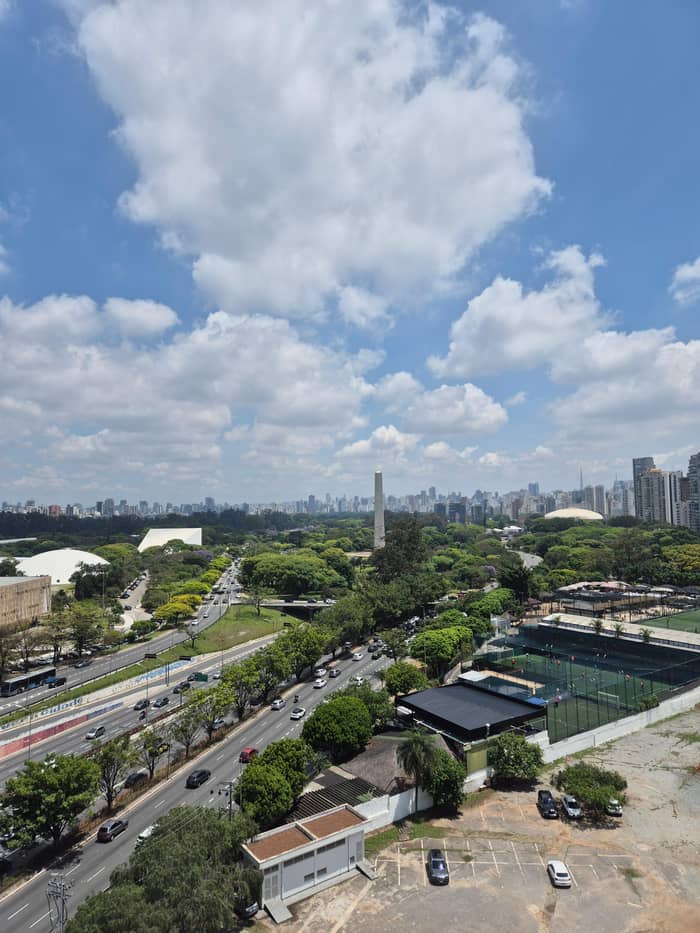
Ibirapuera Park was meant to crown the city's 400th anniversary on 25 January 1954, but it only opened on 21 August that year.93,15 Augusto Teixeira Mendes conceived the park, Oscar Niemeyer designed the cultural buildings, among them the Marquise, the Oca and the Bienal, and Roberto Burle Marx drew the square that carries his name.94,95,96 The name itself comes from a Tupi-Guarani word for a rotten tree, a reminder that this was once swampland.97
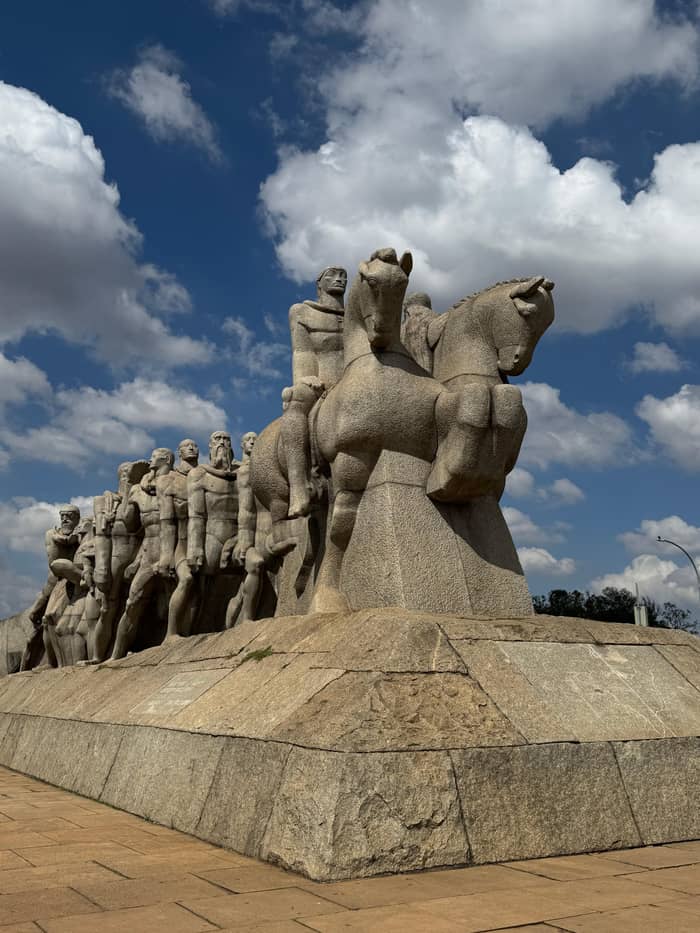
The park covers more than 1.5 km² and the city counts about 220,000 visitors a week.98,99 This site's tour stops here to see the Obelisk and the Bandeiras Monument and to look out from the MAC museum's terrace. Further south-east, the Ipiranga Museum fills a palace built from 1885 to 1890 as a monument to the independence proclaimed in 1822.100,51 Visiting hours run from 10 AM to 5 PM, Tuesday through Sunday, and Wednesdays cost nothing.76,27
FAQ
A Jesuit college went up that day on the hill now called the Pateo do Collegio.1
It is also 46 m wide; the height excludes the towers.2
That is the 2022 census count for the municipality.7
It also passes the Tea Viaduct and City Hall and stops at Batman Alley.
Sources
More to read
Planning a day in Sao Paulo? Ask a real person.